

Bundesbank President Weidmann quits -Breaking
[ad_1]
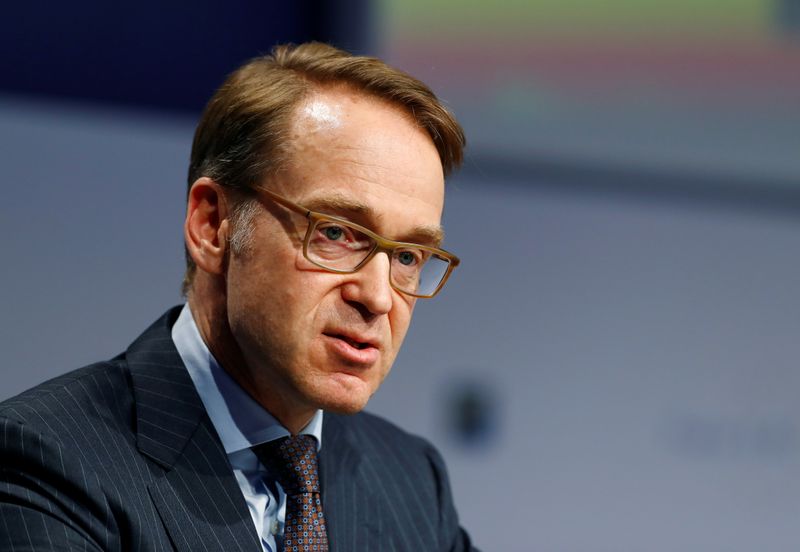 © Reuters. FILE PHOTO: German Bundesbank President Jens Weidmann attends the 29th Frankfurt European Banking Congress (EBC) at the Old Opera house in Frankfurt, Germany November 22, 2019. REUTERS/Ralph Orlowski
(Reuters) – Bundesbank President Jens Weidmann, a relentless critic of the European Central Bank’s ultra-easy monetary policy, will step down from his post on Dec. 31, with more five years left on his term, the German central bank said on Wednesday.
Following are reactions to his resignation:
HOLGER SCHMIEDLING, CHIEF ECONOMIST, BERENBERG
“The new German government will likely appoint a less hawkish successor. Perhaps Isabel Schnabel (currently on the ECB board) or somebody with similar mainstream views.
“Weidmann’s resignation ‘for personal reasons’ may tilt the debate within the ECB a bit more in a dovish direction. But not very much. He is not the only hawk on the ECB council. Also, many mainstream members on the ECB governing council would also be ready to phase out asset purchases earlier and raise rates earlier than current ECB guidance indicates if inflation were to surprise the ECB to the upside.
“Weidmann will still be there when the ECB council decides on 16 December by how much it will scale up the standard APP asset purchases and make them more flexible upon the likely end of – or phasing out of – its pandemic emergency purchases (PEPP) from April 2022 onwards.”
LOUIS HARREAU, EURO ZONE ECONOMIST AND ECB STRATEGIST AT CREDIT AGRICOLE, PARIS
“For me, there are two specific events that will leave a negative mark in Jens Weidmann’s legacy: the reaction to the OMT (public opposition, and testimony at the German Constitutional Court. Not only it hurt the programme but it highlighted the dissensions at the ECB, weakening the overall credibility of the ECB. Same in September 2019, when he publicly opposed to the new APP (asset purchase programme).
“Nevertheless, and more importantly, for me Jens Weidmann has had a way more balanced approach than previous German central bankers: he tolerated the APP, he supported the PEPP, and has had overall a ‘constructive’ opposition to the accommodative monetary policy. And the fact that most of the time, he remained constructive, despite his opposition, allowed the ECB to be more proactive and more efficient.”
Fusion Media or anyone involved with Fusion Media will not accept any liability for loss or damage as a result of reliance on the information including data, quotes, charts and buy/sell signals contained within this website. Please be fully informed regarding the risks and costs associated with trading the financial markets, it is one of the riskiest investment forms possible.
[ad_2]