
Analysis-Investors look to prune portfolio risk as Fed hawkishness rules markets -Breaking
[ad_1]
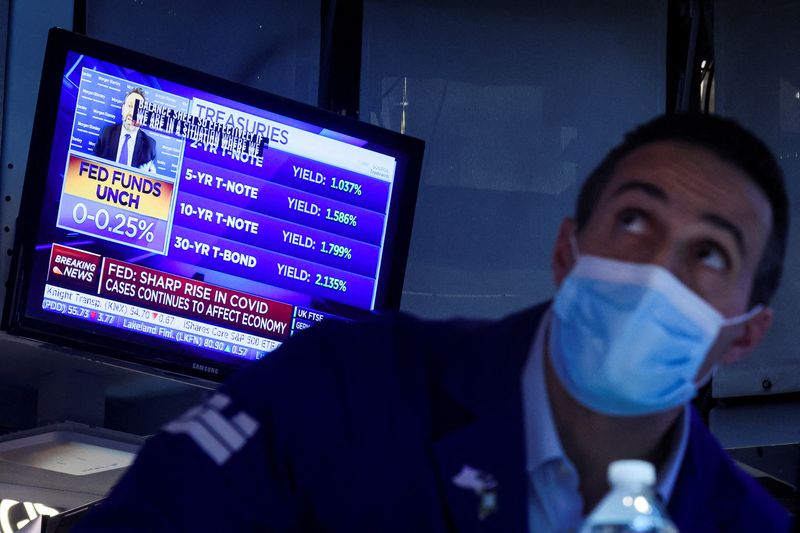 © Reuters. The Fed Rate announcement is displayed on a screen as a specialist trader at work in New York City (USA), January 26, 2022. REUTERS/Brendan McDermid
David Randall and Davide Baruscia
NEW YORK (Reuters) – The Federal Reserve’s hawkish shift is bolstering the case for investors looking to trim risk from their portfolios, as the U.S. central bank trains its guns on surging inflation while giving little indication that it will be swayed by the latest weakness in stocks.
Now that the Fed has eased the market from the March 2020 lows and helped it soar, investors will have to deal with uncertainty. The Fed is now gearing up for higher interest rates as well as shrinking its almost $9 trillion-worth of balance sheets.
“I continue to believe you have to be really conservative in your portfolio today,” said Rick Rieder, BlackRock (NYSE:)’s chief investment officer of global fixed income. “The Fed is going to have to see a few more cards on inflation and the economy, and the uncertainty is high.”
On Wednesday’s conclusion to its latest monetary policy gathering, Fed officials stated that they are likely to raise interest rates in March. They also confirmed plans to cease bond purchases for the month. Fed chief Jerome Powell said the Fed will continue to fight inflation. Some measures show it has reached its highest point since 1982.
Fed Funds Futures are tracking short-term interest rates and now price in 4.4 rate hikes this year. That’s up from the previous four rate increases before Powell spoke.
Markets had been jittery ahead of the meeting, with the S&P 500 down 8.6% for the year-to-date. According to Ned Davis Research, this could put the index on track for the worst January performance ever.
For some investors, the uncertainty means that January’s market swings could be a preview of how asset prices will behave in coming months – a stark contrast from the becalmed markets many had grown used to since the Fed unleashed its massive stimulus programs nearly two years ago.
Additionally, investors seemed to be more cautious about purchasing dips on the U.S. stock exchange, an investment strategy that has proven profitable over the past two decades.
Andy Kapyrin (co-chief investment officer at RegentAtlantic) said that the Fed “has really been the backstop to the market” and has begun shifting more assets into value stock — shares of economically sensitive businesses, which would reap the benefits of rising rates and shorter durations in his bond portfolios.
RJ Gallo is a senior portfolio manager for Federated Hermes. He believes that the Fed will increase rates by 25 basis points starting with its March meeting. In anticipation of the possibility that the yield on the 10-year Treasury bonds will surpass 1.77% by mid-2012, his firm has reduced the durations of its portfolios.
Gallo declared that “The Fed” and the inflation would be the main forces driving the market for 2022. “Nothing has suggested this year that inflation will unwind, and the only way they have to address it is rate hikes and to shrink the balance sheet.”
On Wednesday, Powell’s comments sent U.S. Treasuries yields higher and flattened their yield curve. Investors have worried about Fed tightening so quickly that it could slow down growth and are now focusing their attention on the flattening yield to be a warning sign.
“I think what you end up with is more persistent volatility, which shouldn’t be a surprise – that tends to happen at the dawn of tightening cycles – and a flatter yield curve,” said Steve Bartolini, portfolio manager of T. Rowe Price’s New Income Fund, who said their portfolios were “relatively conservative to begin with.”
The Index has fallen 13.4% in the last year, making it one of the hardest-hit asset classes. The price of cryptocurrencies has plunged to around 20%, with bitcoin now down about 20%.
“We have to be cautious with regards to positioning for risk assets,” said Brian Quigley, portfolio manager at Vanguard Fixed Income Group. “I would not be surprised to see more equity weakness, see more widening in spreads of corporate bonds.”
[ad_2]