

Domestic investors prop up Indian stocks as foreigners flee -Breaking
[ad_1]
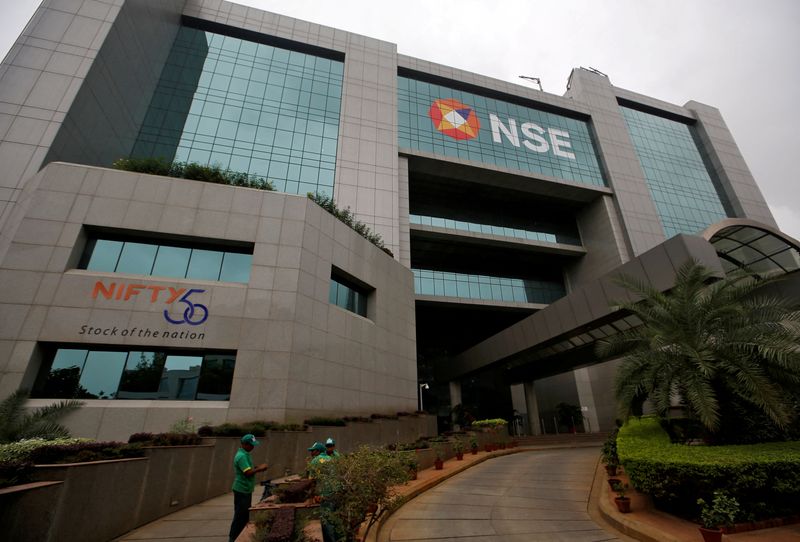 © Reuters. FILE PHOTO: On August 16, 2018, gardeners worked outside Mumbai’s National Stock Exchange (NSE), building. REUTERS/Francis Mascarenhas
By Patturaja Murugaboopathy
(Reuters] – While foreign investors have cut their Indian equities investments over the last several months, domestic mutual funds, banks, and insurance companies have helped to put a ceiling on the market’s buying.
The data of the National Stock Exchange of India shows that foreigners sold $7.24 Billion between October 1 and January 25, while domestic Indian institutions bought $9.63 Billion.
Graphic: Domestic and foreign institutional investments in Indian markets- https://graphics.reuters.com/INDIA-EQUITYFLOWS/INDIA-EQUITYFLOWS/znvnejdenpl/chart.png
Analysts believe that domestic investment has increased due to the increase in interest from retail investors in equity markets. This is because young investors choose stocks over traditional assets.
People start to notice rising incomes, and they put more money into investments for the future. There is also a greater desire to own assets such as equities. Previously, most people saved in property and jewelry. Herald van der Linde (NYSE) is the chief Asia equity strategist for HSBC.
We see retail investors buying more ETFs, funds and stocks. They also purchase ETFs, stocks and funds.
Association of Mutual funds in India data showed that funds had amassed $3.2 billion ($4.38 Billion) in systematic investment plans in the fourth quarter of 2021. This is 40% more than in the same period last year.
Graphic: Mutual fund SIP flows into Indian equities- https://graphics.reuters.com/INDIA-SIPFLOWS/INDIA-SIPFLOWS/lbvgnjqkqpq/chart.png
Because they permit retail investors to put a predetermined amount each month, SIPs are more appealing than traditional stock options. Additionally, their returns tend to be less volatile that those of lump sum discretionary stock investments.
The domestic support can protect Indian markets against volatility, as the U.S. Federal Reserve sets to quickly raise interest rates in an effort to fight higher inflation.
In the last few weeks, many emerging market stock markets have been affected by foreigners selling riskier markets to get higher yields in America and taking a loss on earnings.
The Nifty 50 Index in India has lost 2%, while the MSCI Asia-Pacific index suffered a 5% drop.
Some analysts suggested that India’s high stock values could put off foreign investors. But domestic investors would not stop accumulating shares.
Refinitiv data shows that India’s forward 12-month price to earnings ratio for large and mid-cap stocks was 20.1, which is the highest value in Asia.
Graphic: Valuations of Asian equities- https://graphics.reuters.com/INDIA-SIPFLOWS/INDIA-SIPFLOWS/lbvgnjqkqpq/chart.png
ManishiRaychaudhuri is Asia-Pacific equity strategist for BNP Paribas (OTC).
It seems that this situation will not change over time, which means that the domestic institutional investment flows might continue to serve as a support to the market.
($1 equals 74.8510 Indian rupees).
Additional reporting from Gaurav Dogra, Bengaluru. Editing by Vidya Rangeanathan and Shailesh Kuber.
[ad_2]