
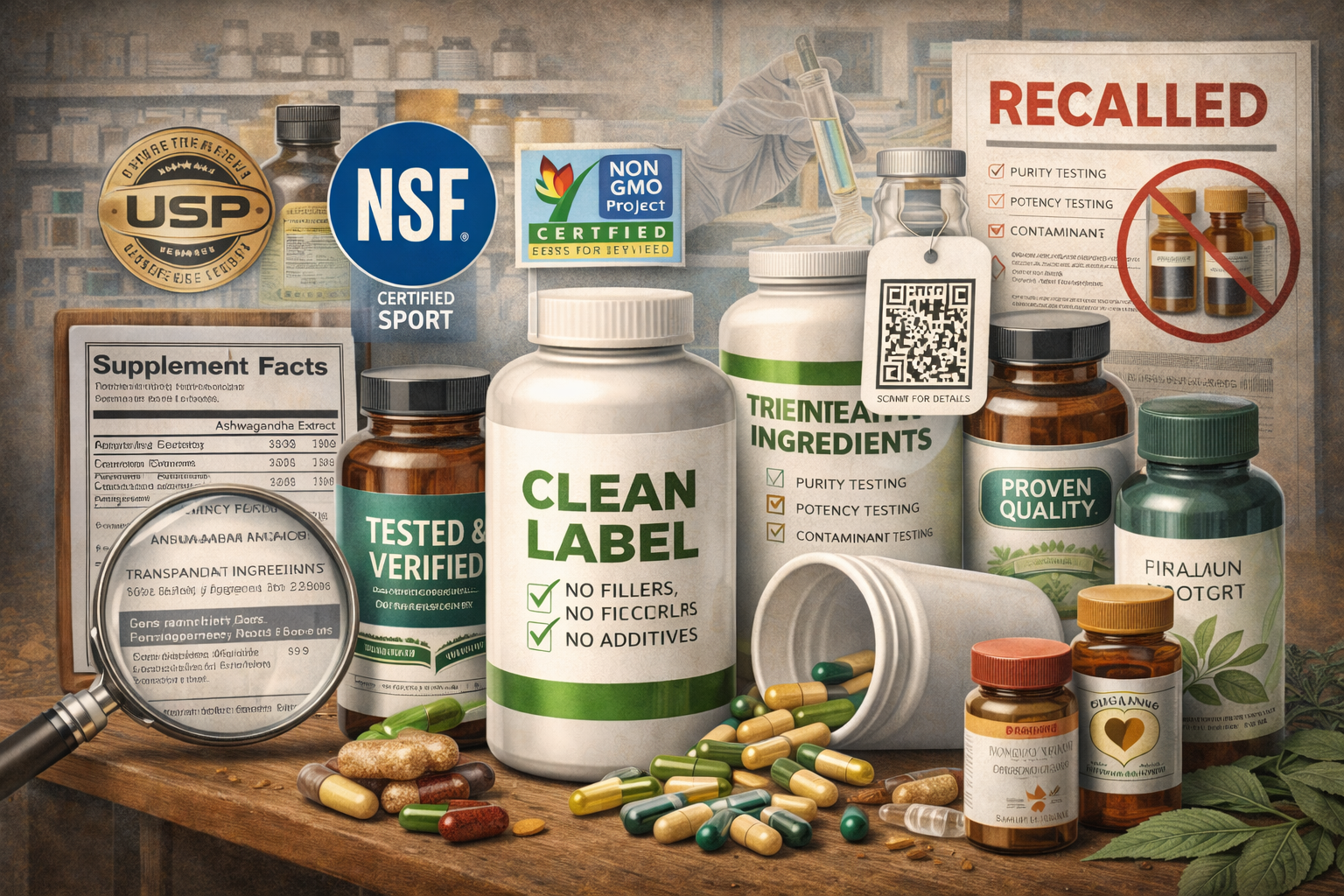
Consumer Demand for Transparency: The Push for Clean Labeling in the Supplement Industry
Clean labeling used to be a niche request from label readers and ingredient purists. In the supplement aisle today, it is turning into a mainstream expectation. The shift is not only about avoiding a few additives. It is about trust in a category where products move fast, e-commerce moves faster, and consumers increasingly feel they have to do their own verification.
That is why supplement industry transparency is becoming a competitive advantage and a regulatory flashpoint at the same time. People are not only asking what a supplement claims to do. They are asking what is inside, how it was made, what was tested, and whether the marketing is backed by real evidence.
This is the clean label era for supplements, and it is being pulled forward by three forces. Label fatigue, fraud fatigue, and a growing belief that brands should prove quality, not just promise it.
Why transparency became the new currency
The supplement market has expanded into a daily habit for many households. Trade association survey results in the United States have repeatedly shown high usage rates, which means more consumers are making repeated purchase decisions and noticing patterns like vague blends, confusing dosing, and aggressive claims.
At the same time, clean label expectations across consumer goods have been rising. Market and retail analysts note that shoppers increasingly reward simplicity and transparency, and that clean-label positioned products are outperforming in some categories.
Supplements are a natural place for that expectation to land because consumers often buy them for prevention, daily support, or self-directed problem solving. The buyer is already taking on some uncertainty. When the label adds more uncertainty, trust erodes.
What clean labeling means in supplements
In food, a clean label often signals short ingredient lists and recognizable ingredients. In supplements, the idea is more complicated because many formulas are designed around concentrates, extracts, and dosage precision.
In practice, clean labeling in supplements usually means six things.
Clear ingredient identity
You can tell what each ingredient is and where it fits in the formula.
Clear dosing
You can see the amount of each ingredient, not only the total blend weight.
Clear non-active ingredients
Fillers, capsule materials, sweeteners, dyes, and flavors are listed in plain language, not hidden behind vague terms.
Clear claims boundaries
The product avoids disease claims and does not imply it can treat or cure.
Clear quality signals
The brand shows evidence of testing and manufacturing controls, not only marketing language.
Clear accountability
The company name, location, and contact details are easy to find.
Some of these are already expected by regulators in many markets. In the United States, FDA consumer guidance describes basic labeling elements like a Supplement Facts panel, an ingredient list for other ingredients, net quantity, and manufacturer information. In the European Union, the European Commission’s overview of the food supplements framework points to specific rules under the food supplements directive and related labeling requirements.
So why is transparency still a problem if labeling rules exist? Because compliance is the floor, not the ceiling.
The proprietary blend problem sits at the center
If there is one label feature that captures why consumers feel uneasy, it is the proprietary blend.
A proprietary blend can legally list a combined weight while withholding the specific amounts of each ingredient. That creates a trust gap because the buyer cannot judge whether an ingredient is meaningfully dosed or sprinkled in for marketing. The Operation Supplement Safety site explains how proprietary blends work on Supplement Facts panels and why individual ingredient amounts may not be disclosed. (Office for Product Safety and Standards)
Researchers have also discussed how proprietary blends complicate both consumer decision-making and scientific evaluation because the exact formulation is unclear.
Brands argue that blends protect intellectual property. Consumers increasingly argue that if the product is meant to influence health, dosing should not be a secret. That tension is a big driver of supplement industry transparency demands.
Fraud, contamination, and the trust penalty
The other major driver is not aesthetic. It is safe.
Over the last few years, regulators and public health bodies have continued to publish warnings and recall notices tied to supplements that were tainted, adulterated, or contaminated.
In December 2025, the US FDA warned about heavy metal poisoning linked to certain unapproved ayurvedic drug products and described health risks tied to high levels of heavy metals.
In December 2025, the FDA also published a recall notice for a product marketed as a dietary supplement that was found to be tainted with prescription drug ingredients used for erectile dysfunction.
These events land directly on the label trust question. When consumers see repeated warnings about undeclared ingredients and contaminants, they stop treating labels as neutral information. They treat labels as marketing that might be incomplete.
Regulators are responding with more public tracking. The FDA Health Fraud Product Database lists products tied to health fraud-related violations, including those involving undeclared ingredients or illegal disease claims.
The trend line is clear. Transparency is no longer just a brand virtue. It is a risk control tool.
Advertising enforcement is pushing transparency from another angle
Even when a supplement is correctly labeled, advertising can overreach.
The FTC states that advertising claims must be truthful, not deceptive, and evidence-based. The agency has continued to announce enforcement actions and consumer refunds tied to deceptive claims and review practices in the supplement space, including a July 2025 refund announcement tied to deceptive marketing.
This matters for clean labeling because consumers experience the label and the ad as one package. If the ad promises dramatic outcomes and the label hides the dosage behind a blend, trust collapses quickly.
Third-party verification is becoming a clean-label shortcut
Because most consumers do not have the tools to audit a supply chain, third-party verification has become a practical substitute for trust.
Programs like the USP Dietary Supplement Verification Program promote the idea that a verified product gives consumers confidence that the label matches the contents and that certain quality criteria are met.
NSF also offers certification programs that emphasize testing for contaminants and label claim verification, including NSF Certified for Sport for products used by athletes who face extra risk from banned substances.
This is one reason the clean label trend in supplements is not only about removing ingredients. It is about proving what is there, and proving what is not there.
Digital transparency is replacing label real estate
There is a practical constraint. Bottles are small. Formulas are long. Compliance text is required. Brands want marketing space. Consumers want more detail.
The compromise is digital transparency.
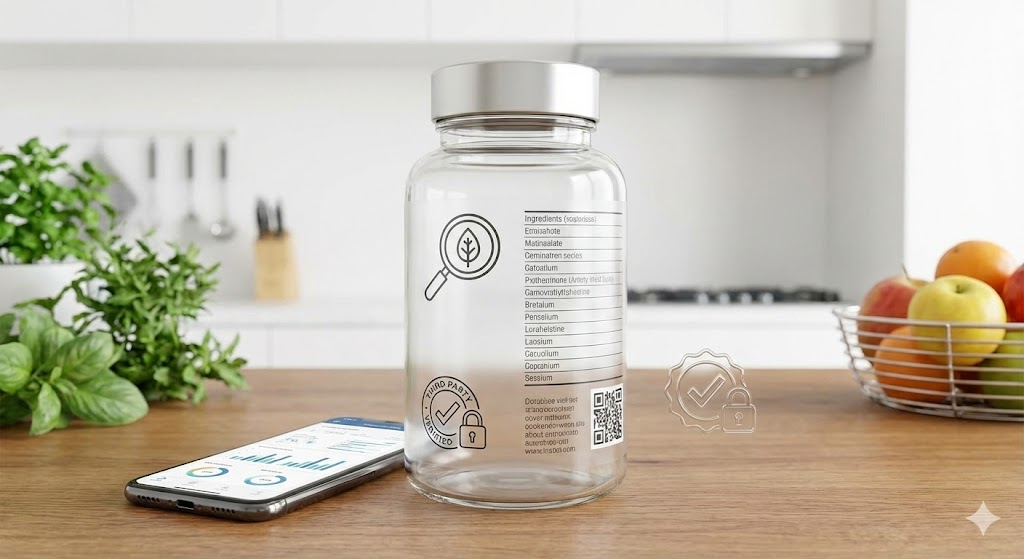
More brands are using QR codes and batch-specific pages that show certificates of analysis, contaminant testing, and sourcing notes. This is not regulated in a single uniform way, but it is becoming an expected feature in premium segments because it lets brands provide depth without crowding the label.
This also aligns with the direction of manufacturing accountability. In the United States, companies that manufacture, package, label, or hold dietary supplements are subject to dietary supplement current good manufacturing practice rules under 21 CFR Part 111. Clean label in supplements increasingly implies not only good ingredients, but also good process.
The influencer era accelerated the demand for proof
Another reason transparency expectations rose is that supplement discovery moved to social feeds.
Creators can scale a product faster than a regulatory warning can circulate. When that happens, consumers learn a hard lesson. Popular does not mean verified.
Some large online educators influence how people interpret supplements and ingredient lists, and Dr. Berg is often part of those broader online nutrition conversations. For readers who want a general reference point for how high-volume health education content is packaged and discussed, you can start with the Dr. Berg blog.
The key point is not about any single educator. The key point is that social distribution increases the speed of buying decisions, which increases the need for transparent labels and verifiable quality signals.
What transparency leaders in the industry are doing now
Brands that are leaning into supplement industry transparency are converging on a recognizable playbook.
They avoid proprietary blends or explain them clearly
They publish batch testing details, sometimes per lot
They use third-party verification marks when feasible
They simplify excipients and disclose allergens clearly
They keep claims conservative and evidence aligned
They show where the product is made and how quality is controlled
None of this guarantees a product works for every person. It does reduce the likelihood of the worst-case scenarios, which is what many consumers are really paying for.
Where the trend is heading
The clean label push in supplements is unlikely to fade because it is anchored in structural realities.
More consumers use supplements regularly, which increases scrutiny over time.
Regulators continue to publish warnings, recalls, and fraud lists, which keeps trust fragile.
Advertising enforcement keeps reminding brands that claims must be backed by evidence.
Third-party verification systems keep expanding as a practical trust tool.
Over the next few years, expect transparency to become less of a marketing differentiator and more of a baseline expectation in competitive segments. Brands that treat transparency as an extra will keep losing ground to brands that treat it as a default.