
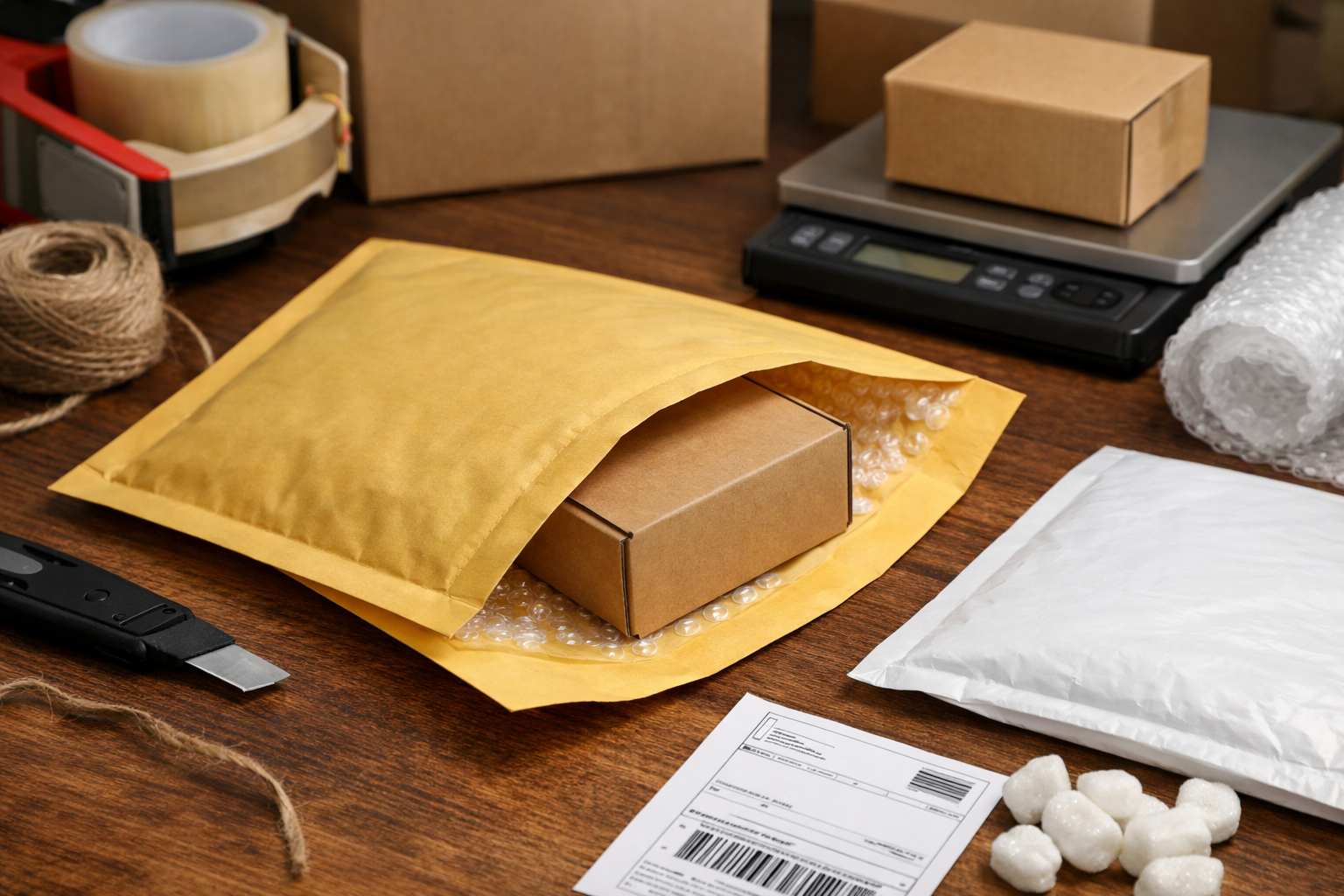
How Envelope Mailers Help Small Brands Reduce Dimensional Weight in 2026
Key Takeaways
- Match envelope mailers to the item, not habit: poly mailers work for soft goods, bubble mailers fit light fragile items, and rigid envelopes protect contracts, catalogs, and photos without paying box-level dimensional charges.
- Check how carriers classify each envelope, flat, and padded mailer before buying stock, because a piece that looks like a standard envelope can price as a package once thickness, rigidity, or label placement changes.
- Reduce shipping cost by building a simple size matrix for envelope mailers, using only the smallest mailer that clears the item and closure flap without wasted air or extra void fill.
- Standardize addressing, shipping label placement, and postage rules for every mailer type so office staff can pack faster, avoid return issues, and keep daily mail moving without guesswork.
- Compare envelope mailers against boxes by full trip cost, not unit price alone, since lower package weight, less storage space, and faster packing often beat the few cents saved on a larger carton.
- Track mailer use, postage, and damage claims each month, replace poor-fit envelopes with better sizes or padded options before small packing errors turn into repeat overspending.
Shipping rates don’t need much room to get expensive. A flat item sent in a box can trigger package pricing, extra void fill, and higher dimensional charges all at once. Envelope mailers give office teams and small brands a simpler fix: reduce package size, keep parcels closer to flat, and stop paying to ship air.
That matters more in 2026 because carriers keep rewarding compact packs and punishing wasted space. In practice, a contract packet, catalog, fabric sample, or folded apparel order often doesn’t need corrugated boxes at all—it needs the right envelope, the right stiffness, and the right closure. Get that choice wrong and postage climbs, damage claims follow, and staff lose time guessing between padded, poly, bubble, or rigid formats. Get it right—and this is where the savings show up fast—and daily mail starts moving with fewer surprises, cleaner label placement, and lower cost per shipment. The Boxery notes that size depth matters here; one or two envelope options rarely solve a real shipping desk’s workload.
Why envelope mailers matter more in 2026 for dimensional weight and shipping cost control
How carriers price flat packages, boxes, and padded mailers
Dimensional weight is still the quiet budget killer in 2026. A box that measures 12 x 10 x 4 can bill higher than a flatter mailer carrying the same item, even before surcharges and zone-based shipping rates show up on the invoice. For office teams sending contracts, catalogs, samples, or media, Envelope mailers often keep parcels in a lower billable footprint than boxes.
Why small brands are rechecking package size, postage, and shipping rates now
Carriers keep tightening how they treat oversize packaging, and that hits small brands first.
Where envelope mailers fit for apparel, catalogs, contracts, samples, and media mail
Flat goods are the obvious fit, but the category is wider than most shipping desks think. Apparel, slim catalogs, paper samples, signed contracts, photos, books, and small parts can all move in mailers if the item stays stable and the closure holds; that matters for usps acceptance, first class options, priority handling, and even media mail screening.
Which envelope mailers cut dimensional weight without raising damage claims
Poly mailers vs bubble mailers vs padded paper envelopes for different product types
Material choice decides whether a mailer saves money or creates returns. Poly works well for soft goods — non-breakable items, bubble mailers suit cosmetics, cords, and light electronics, while padded paper styles work for documents and flat merchandise that need some crush resistance without the bulk of boxes.
And that’s where most mistakes happen.
In practice, office staff should sort by risk, not habit. A shirt in a poly mailer doesn’t need bubble. A signed legal packet shouldn’t slide inside a thin envelope. And a sample kit with corners that can punch through the side needs a tougher padded mailer—or a box.
Flat mailer sizes, standard envelope sizes, and large envelope choices that avoid wasted space
Here’s what most people miss: poor size matching creates both postage waste and damage. If the item measures 9 x 12, a 10 x 13 mailer is usually safer than jumping to a much larger envelope that leaves dead space, wrinkles the label, and invites handling issues.
- Small mailers: receipts, parts lists, cards, photos
- Standard flats: contracts, catalogs, print packets, media inserts
- Large mailers: apparel, document sets, folded posters, sample packs
When a rigid mailer or chipboard-backed envelope works better than boxes
Rigid mailers earn their keep with photos, certificates, art prints, and documents marked do not bend. They hold shape better than a soft padded envelope and often ship lighter than recyclable corrugated stock, which can lower total cost while keeping the piece flat.
How custom envelope mailers and printed labels affect packing speed and brand presentation
Packing speed is a real cost. A custom size that fits the item, a print area that stays clear for the address, and a label position staff can repeat without guessing—those details save seconds on every order, which turns into hours by month-end (and fewer reworks at the pack table).
It’s not the only factor, but it’s close.
Teams that use Shipping envelopes with preplanned label zones usually see cleaner addressing, fewer voided labels, and less tape use. That’s not flashy. It works.
The direct buying question: when is an envelope mailer cheaper than a box?
Cost comparison by package type: first class, priority mail, and ground shipping scenarios
An envelope mailer is cheaper than a box when three things line up: the item is flat, damage risk is controlled, and the final thickness stays inside the right class rules. A catalog, contract packet, or shirt can often move at a lower rate in a mailer; a boxed version may trigger higher package pricing, more fill, and heavier billable weight.
One common office scenario proves it. A 12-ounce stack of sales sheets in a padded flat mailer may stay in a lower shipping band, while the same packet in a small corrugated box picks up extra ounces, more cubic size, and a higher ground charge.
Postage, stamps, prepaid options, and rate factors office teams should check before sealing
Before sealing, staff should confirm weight, thickness, rigidity, and closure style. Forever stamps and standard stamp use make sense only for true letter or large envelope rules; once the piece becomes a package, prepaid labels, online postage, or meter rates usually make more sense than guessing at the counter.
No shortcuts here — this step actually counts.
USPS rules on large envelope, letter, and package classification that change total cost
The usps draws hard lines between letter, flat, and package treatment. Shape, bendability, and uniform thickness matter.
For quick rule checks, staff should keep the USPS letter and flat guide, the Domestic Mail Manual, and the Priority Mail page bookmarked at the mail station.
Free mailing supplies, priority envelope options, and where paid stock still makes more sense
Yes, usps does offer free priority envelope stock for qualifying services. But those free supplies only help if the item fits the service and the rate makes sense. If the team is sending first class documents, non-priority flats, or mixed daily mail, paid stock in the right sizes usually gives better control.
Reference pages from the USPS business mail center, the First-Class Mail FAQ, and the postage calculator should be part of training. They prevent expensive assumptions.
It’s a small distinction with a big impact.
How office teams can choose the right envelope mailers for daily mail and order fulfillment
Best envelope mailer picks for contracts, catalogs, photos, flat merchandise, and small parts
Different contents need different stock. Contracts and legal packets do well in stiff document mailers. Catalogs usually fit catalog envelopes or paper-backed flats. Photos need rigid protection. Flat merchandise like patches or lightweight accessories can ride in bubble or poly, while tiny hardware parts need padded walls and a secure seal.
That’s where kraft paper mailers work well for paper-heavy shipments, and Economy mailers make sense for routine office mail where appearance, protection, and low unit cost all matter. For bulky document sets, expandable kraft mailers give extra depth without switching to a box.
Addressing, shipping label placement, and print standards that prevent returns and surcharges
Bad label placement causes real trouble.
Labels should sit on the flattest face, away from seams, folds, and closure lips. Addressing has to stay readable with no tape glare over the barcode, and print contrast needs to be high enough for sorting equipment to scan on the first pass.
Staff should use the USPS address quality tools, the addressing standards page, — the address information API notes if they print labels from order software or an ebay store. It cuts returned mail. Fast.
Worth pausing on that for a second.
Padded mailer strength, bubble protection, and poly thickness for common small business use cases
For office use, 2.5 mil poly is a solid starting point for clothing and soft goods. Bubble interiors help with cosmetics, accessories, and compact electronics. Paper padding works for brochures, folded print jobs, and packets that need cleaner presentation but not heavy cushioning.
Product teams looking at greener options should compare recyclable mailing boxes with flatter paper-based alternatives. In some workflows, paper mailers lower waste and still keep the shipment inside a smart cost range.
Useful references include the FedEx packing guide, the size and weight tips, and the commerce shipping trend data. They help teams match protection to risk instead of overpacking everything.
A 2026 packing workflow that keeps mailers compliant and easy to reorder
Create a simple mailer matrix by item size, weight, and postage class
Start with a one-page matrix. List the item, finished packed size, target weight, approved mailer, and approved mail class. A contract packet might map to a flat document mailer and large envelope postage; a sample pouch may map to a bubble mailer and ground service. No guesswork.
Teams that buy Shipping envelopes, kraft paper mailers, Economy mailers, expandable kraft mailers, recyclable mailing boxes, and paper mailers should assign each one to a job code or SKU family. That makes reordering cleaner and training faster.
Standardize envelope, label, and stamp decisions across staff to cut packing errors
Blunt truth: most mailing mistakes come from too many choices at the table. If three staff members use three different envelope sizes for the same document set, postage and appearance drift all month. Standard stock, standard label maker settings, and standard stamp rules fix that quickly.
- Choose one approved mailer per item type
- Set one label location for each size
- Record when to use stamps, prepaid labels, or counter postage
- Train every staff member the same way
Track shipping cost, damage rate, and mailer usage each month to spot waste fast
Every month, review three numbers: average shipping cost per item, damage or return rate, and mailer use by size. If one large padded envelope is being used for five different items, that usually signals oversizing. And oversizing means money leaking out one shipment at a time.
This is the part people underestimate.
Useful tracking references include the postage rate summary, the small business mail page, the FedEx rate tools, and the small business operations hub. Build the habit once, and the savings tend to keep showing up.
Brief expert note on stock depth and size availability from The Boxery
Stock depth matters more than people expect—especially for offices that ship contracts, catalogs, samples, or flat merchandise every day. The Boxery is one supplier that covers a wide range of envelope, bubble, poly, padded, and flat mailer sizes, which makes it easier for staff to stick with the matrix instead of substituting the wrong package when one size runs out.
Frequently Asked Questions
Does the USPS give free bubble mailers?
Yes, but only for specific Priority Mail services. Those free bubble mailers and mailing envelopes must be used with the matching USPS service, not for First Class, Media Mail, or regular stamps.
Does the Dollar Tree sell mailers?
Some discount stores carry basic mailers, padded envelopes, or small shipping supplies, but stock changes a lot. For business use, that’s rarely a dependable way to buy envelope mailers because sizes, pack counts, and quality can be inconsistent.
Does USPS have mailing envelopes for free?
USPS offers free envelopes and mailers for certain services, mostly Priority Mail and Priority Mail Express. If a shipment goes by standard letter mail, First Class, or another lower-cost option, the packaging usually isn’t free and you’ll need your own envelope or mailer.
Is it cheaper to send a mailer or box?
Usually a mailer is cheaper. A flat poly, paper, or padded mailer uses less material, weighs less, and often avoids the higher shipping rates tied to bulky boxes.
What can be shipped in envelope mailers?
Envelope mailers work best for contracts, catalogs, photos, samples, soft goods, and other flat or low-profile items. If the contents are fragile, choose bubble mailers or padded options; if the item can bend, add chipboard or switch to a rigid mailer.
The difference shows up fast.
Are bubble mailers considered envelopes or packages?
They can be treated as either, based on thickness, weight, and what is inside. A bubble or padded envelope with merchandise often enters the system as a package, which affects postage, label format, and available rate options.
What size envelope mailer should be used?
Pick a mailer that leaves just enough room for the item and any padding. Too much empty space drives up shipping cost, makes address labels harder to place cleanly, and can let contents slide around in transit.
Can envelope mailers be used for documents and contracts?
Absolutely. For contracts and other paper records, a catalog envelope or rigid flat mailer usually works better than a box because it keeps papers neat, keeps postage lower, and looks more professional when it arrives.
Do envelope mailers need a shipping label or just stamps?
It depends on weight, size, and service. A light paper envelope may use a stamp or forever stamps, but most business shipments in poly or bubble mailers need a printed label with tracked postage.
Are custom envelope mailers worth it for a small business?
Sometimes, yes. Custom envelope mailers can look sharper and help with brand recognition, but the honest answer is that fit and protection matter more than fancy print when a team is trying to control shipping cost.
By 2026, the cheapest shipment often isn’t the lightest one. It’s the one packed to fit the contents without wasted depth, bad classification, or extra protection that was never needed in the first place. That’s why Envelope mailers have become such a practical cost-control tool for office teams and small brands mailing contracts, catalogs, samples, media, and flat merchandise. A well-matched mailer can trim billed size, speed up packing, and keep daily shipping decisions far less messy.
But the savings only hold if the mailer matches the job. Soft goods may do fine in poly, fragile small items may need bubble, and documents or photos often need rigid support to avoid bends, returns, and remake costs.
For more great reading, visit our site and explore related topics.